The approval workflow
When a depositor submits an item, it doesn't publish immediately — it enters a review workflow. The RIC is the academic gatekeeper: nothing in an academic collection goes public until a reviewer approves it.
Where the RIC sits
The repository's collections each have a review step. The RIC is bound as the reviewer across all 246 academic collections, so RIC reviewers have the last word on academic content — they can approve it, edit it, reject it back to the depositor, or return it to the pool — without needing full administrator access.
Governance content is separate
The University Collections community (Charter, Senate policies, annual reports) is not in the RIC's remit — those are edited by site administrators only. See Collections & communities.
How a task reaches you
Submissions for collections you review appear in MyDSpace:
- Pooled tasks — waiting for any eligible reviewer. You claim one to work on it.
-
Your tasks — items you've already claimed and are responsible for.
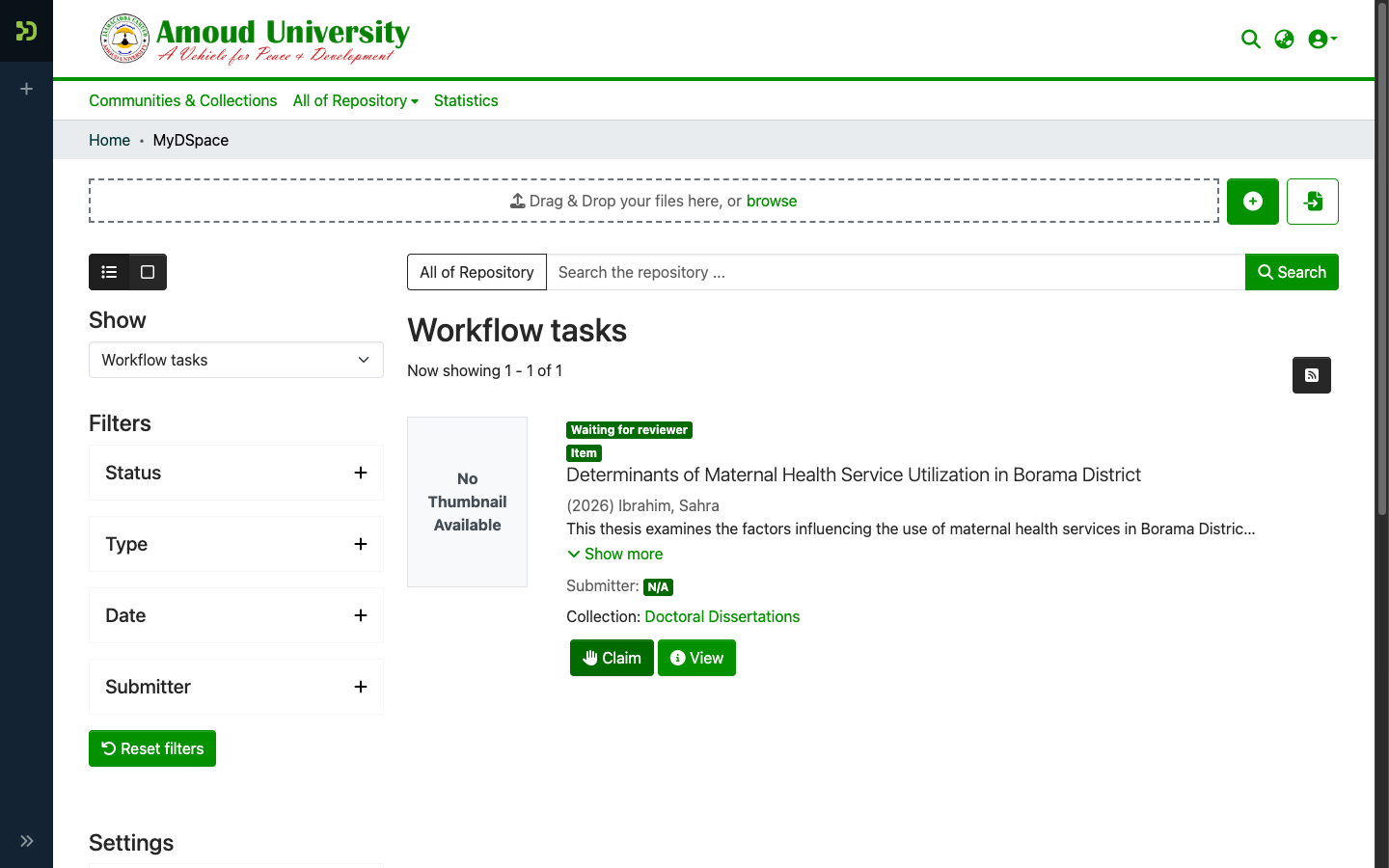
What you can do with a task
Once you've claimed a task, you can:
- Approve — publish the item. This is the action that mints its DOI and ARK.
- Edit — open the submission and correct the metadata or replace the file yourself, then approve.
- Reject — send the item back to the depositor with a reason you type, so they can fix it and resubmit. Nothing is published and no DOI is minted.
- Return to pool — release the task so another reviewer can take it (it stays with the reviewers, it does not go to the depositor).
Reject sends it back to the depositor — with your reason
Choosing Reject opens a reason box. Whatever you write there is what the depositor sees when the item returns to their MyDSpace, so make it specific. The next page walks through choosing between Edit (fix it yourself) and Reject (hand it back).
Accepting is irreversible in one way that matters
Accepting publishes the item and mints a permanent DOI. An ARK is local and can be managed, but a DOI, once registered with Crossref, is meant to last forever. Be sure before you accept — see Reviewing a submission and The copyright gate.
Pilot context
The first production load is the 50-thesis pilot, run by the RIC. It uses two accounts — one to upload, a different person to approve — so the same review steps on this page apply. Administrators handling the bulk load should also read Bulk import (SAF).